

JP Monthly Review | July 2026: Press freedom under siege, courts take center stage
JournalismPakistan.com | Published: 31 July 2026 | JP News Desk
Join our WhatsApp channel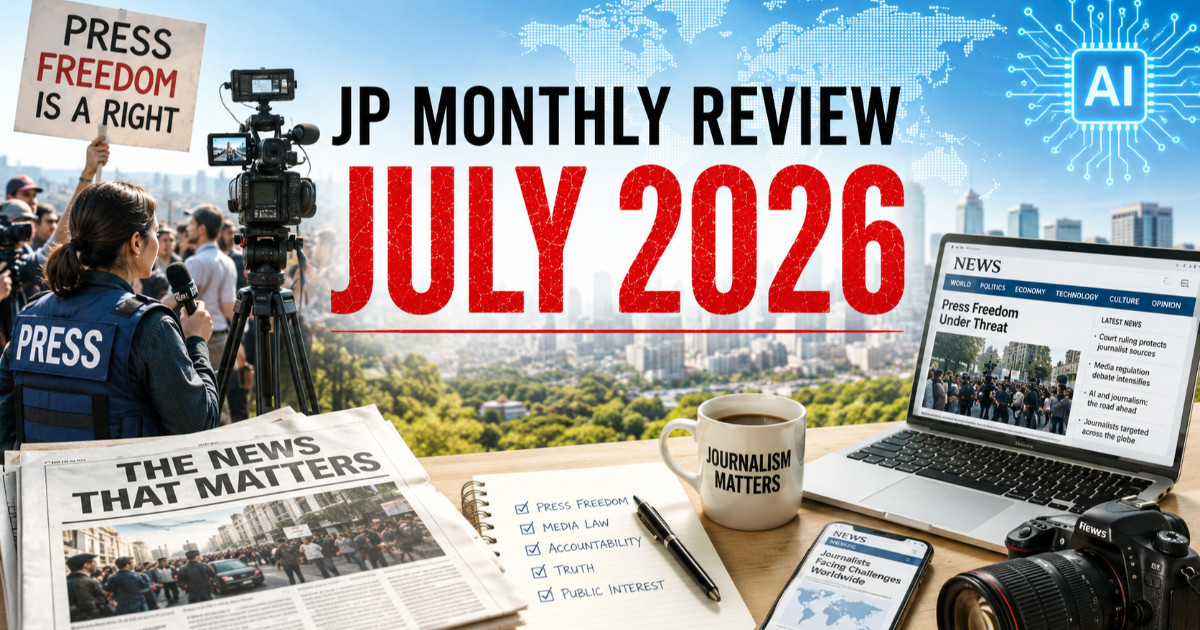
July 2026 saw press freedom tested in courts, parliaments and by regulators as arrests, prosecutions and new cyber laws constrained media. Simultaneously, AI debates, industry consolidation and demands for fair content use reshaped news business models.Summary
Editor's note
July 2026 underscored a defining reality for journalism worldwide: the profession is increasingly being shaped not only by political pressure but also by courtrooms, legislatures, regulators, and national security policies. Across continents, governments continued testing the boundaries of press freedom through arrests, prosecutions, visa restrictions, cybercrime laws, and regulatory interventions, while judges were repeatedly called upon to determine the limits of media access, source protection, competition, and free expression.
At the same time, the global news industry continued adapting to rapid technological change. Artificial intelligence remained central to discussions about journalism's future, media companies pursued large-scale consolidation, and publishers intensified calls for fair compensation for content used to train AI systems. Despite mounting legal, political, and financial pressures, journalism continued to demonstrate resilience, documenting conflict, exposing public issues, and defending the public's right to know.
As these developments unfolded, JournalismPakistan remained committed to tracking the stories that matter most to journalists, news organizations, and everyone concerned about the future of independent media.
Introduction
If June showed that journalism's challenges had become structural, July demonstrated how deeply those pressures are now embedded within legal, political, and technological systems.
Throughout the month, JournalismPakistan covered developments spanning dozens of countries, highlighting a profession confronting escalating restrictions on press freedom alongside far-reaching debates over media regulation, artificial intelligence, public accountability, and industry consolidation.
The stories published during July revealed an increasingly complex media environment. Journalists faced detention, prosecution, intimidation, assaults, and legal action in multiple regions. Governments expanded the use of cybercrime legislation, national security laws, accreditation controls, and regulatory powers affecting media organizations, while courts issued significant rulings on press access, source protection, broadcasting, competition, and freedom of expression.
Yet July also demonstrated journalism's persistence. International press freedom organizations continued challenging government actions, journalists secured important legal victories, newsrooms defended editorial independence, and industry leaders intensified calls for sustainable business models in an era increasingly shaped by artificial intelligence.
Collectively, these developments illustrate an industry navigating profound legal, technological, and political transformation.
At a glance
Coverage highlights
• More than 45 international media stories published
• Coverage spanning over 30 countries
• Five continents represented
Dominant themes
• Press freedom
• Courts and media law
• Government regulation
• Artificial intelligence
• Media business
• Journalist safety
1. The month in perspective
No single story defined journalism during July. Instead, the month reflected the growing convergence of law, politics, technology, and media.
Legal institutions assumed an increasingly prominent role in shaping journalism. Courts ruled on media access, press freedom, defamation, broadcasting regulation, confidential sources, digital competition, and major corporate mergers, reinforcing the judiciary's expanding influence over how journalism operates.
Governments also continued asserting greater control over information through legislation, cybercrime laws, national security measures, visa policies, and broadcasting regulation. Whether justified on security, misinformation, or public-order grounds, these actions collectively demonstrated an international trend toward tighter oversight of journalism and digital communication.
Conflict remained among the most dangerous environments for reporters. Developments linked to Gaza, Israel, Iran, and other regional tensions again illustrated the extraordinary difficulties journalists face when covering wars, political transitions, and humanitarian crises.
Meanwhile, the economic transformation of the media industry continued. Consolidation, streaming competition, regulatory reviews, and copyright disputes reflected an industry still searching for sustainable business models while adapting to rapidly changing technologies.
July ultimately showed that journalism is increasingly being shaped as much by legal institutions and public policy as by technological innovation.
2. Press freedom watch
Press freedom remained under sustained pressure throughout July.
Journalists were arrested or detained in Hong Kong, Morocco, Somalia, Cambodia, Zambia, Azerbaijan, Cuba, and elsewhere. Reporters faced assault while covering protests in India and the occupied West Bank, while independent media organizations encountered legal proceedings, financial penalties, censorship, newsroom raids, and administrative restrictions.
International organizations including the Committee to Protect Journalists, Reporters Without Borders, the International Federation of Journalists, the International Press Institute, Human Rights Watch, and the Media Freedom Coalition repeatedly called for governments to protect journalists, release detained reporters, uphold due process, and defend media independence.
Several incidents also highlighted growing concern over attacks by non-state actors, demonstrating that journalists increasingly face threats not only from governments but also from politically polarized societies.
3. Governments versus journalism
Government intervention remained one of the defining characteristics of July.
Authorities relied on national security legislation, cybercrime laws, broadcasting regulation, visa restrictions, and administrative measures affecting journalists and media organizations across Asia, Africa, Europe, and North America.
New visa limits for foreign journalists, prosecutions under cybercrime legislation, restrictions on media access, and expanded regulation targeting misinformation illustrated how governments are increasingly attempting to shape information ecosystems through legal and regulatory tools.
At the same time, several governments promoted dialogue with media organizations or participated in regional initiatives examining journalism's future, reflecting the growing recognition that media policy has become a strategic issue extending beyond domestic politics.
Although these developments occurred under widely differing political systems, together they reflected a broader international trend toward greater governmental influence over journalism.
4. Media business & broadcasting
Business transformation continued reshaping the global media industry throughout July.
The proposed Paramount–Warner Bros. Discovery merger remained one of the year's most closely watched corporate developments as regulators, courts, consumer groups, and state governments weighed its implications for competition and media ownership.
Broadcast regulation also emerged as an important theme, with disputes involving television licensing, broadcasting oversight, and regulatory independence highlighting continuing tensions between governments and media organizations.
Meanwhile, publishers and broadcasters continued adapting to rapidly evolving streaming markets, digital competition, and changing audience behavior, underscoring the ongoing search for financially sustainable models.
5. AI & digital transformation
Artificial intelligence remained central to journalism's long-term future.
Industry leaders increasingly argued that AI companies must fairly compensate publishers whose reporting is used to train large language models, while news organizations continued balancing AI adoption with concerns about copyright, attribution, editorial integrity, and sustainability.
The month's discussions demonstrated that AI is no longer viewed simply as an editorial tool. It has become a strategic issue encompassing intellectual property, newsroom economics, platform relationships, and the future financing of journalism itself.
6. Public service media
Public-interest journalism continued facing significant institutional pressures.
Questions surrounding regulatory independence, editorial freedom, media governance, and broadcaster accountability remained prominent throughout July as policymakers, regulators, and courts examined the future role of trusted news organizations in increasingly fragmented information environments.
These developments reinforced the continuing importance of independent public-interest journalism during periods of political polarization and rapid technological change.
7. Reports and statements that mattered
Although July produced fewer landmark industry reports than previous months, influential statements from leading organizations shaped debate across the profession.
CPJ, RSF, IFJ, IPI, Human Rights Watch, the European Commission, and the Media Freedom Coalition collectively highlighted deteriorating press freedom conditions, attacks on journalists, restrictions on access, and the importance of safeguarding independent reporting.
At the same time, Reuters Editor-in-Chief Alessandra Galloni's call for fair AI licensing arrangements reinforced growing industry consensus that sustainable journalism depends on equitable relationships between publishers and technology companies.
Together, these interventions reflected an increasingly coordinated international effort to defend journalism during a period of rapid change.
8. Five trends JP identified
- Courts are playing an increasingly influential role in shaping journalism.
- Governments continue expanding legal and regulatory control over media.
- Artificial intelligence is becoming central to journalism's economic future.
- Press freedom challenges remain widespread across every region.
- Media organizations continue adapting to consolidation, digital competition, and technological disruption.
9. Looking ahead
Several issues are expected to dominate media coverage during August.
Artificial intelligence and publisher licensing agreements are likely to attract increasing attention as news organizations continue seeking sustainable relationships with technology companies.
Legal disputes involving media regulation, competition, source protection, and freedom of expression are expected to remain prominent as governments continue refining digital policies and courts address new challenges arising from journalism's changing landscape.
Meanwhile, journalists covering conflicts, political unrest, and elections around the world will continue operating under difficult conditions, ensuring that press freedom, journalist safety, and independent reporting remain central concerns for the international media community.
Missed our June review? Read it here for a look at the key developments that shaped global journalism.
ATTRIBUTION: Analysis by JournalismPakistan.
PHOTO: AI-generated; for illustrative purposes
Key Points
- Courts increasingly decided disputes over access, source protection and limits to reporting.
- Governments used arrests, prosecutions, visa limits and cybercrime laws to curb journalists.
- Debates over AI, training data and content compensation accelerated across publishers.
- Media consolidation continued as companies pursued scale amid financial pressures.
- Despite pressures, journalists kept documenting conflicts and exposing public interest issues.
Key Questions & Answers
How did courts shape press freedom in July 2026?
Judges ruled on access, source protection, competition and free expression, making courts a key arena where limits on reporting were determined.
What legal tactics did governments use against media?
Authorities used arrests, prosecutions, visa restrictions, cybercrime laws and regulatory interventions to limit reporting and apply pressure.
What role did AI play in media developments?
Artificial intelligence dominated discussions about journalism's future, especially around training data, automated reporting and fair compensation for content use.
How did the news industry respond to these pressures?
Publishers pursued consolidation, sought legal remedies, advocated for compensation for content used in AI, and adapted operations while journalists continued reporting.
Relevant Topics
Ask AI: Understand this story your way
AI EnabledDig deeper, ask anything — get instant context, background, and clarity.
Disclaimer: This feature is powered by AI and is intended to help readers explore and understand news stories more easily. While we strive for accuracy, AI-generated responses may occasionally be incomplete or reflect limitations in the underlying model. This feature does not represent the editorial views of JournalismPakistan. For our full, verified reporting, please refer to the original article.