
Time for more women to lead media and unions, says IFJ
JournalismPakistan.com | Published: 7 March 2019
Join our WhatsApp channel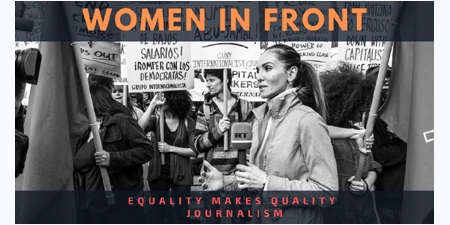
On International Women's Day, the IFJ calls for increased visibility and leadership of women in media and unions. The #WomenInFront campaign highlights the need for gender equality and encourages organizations to adopt policies addressing this imbalance.Summary
BRUSSELS - To mark International Women's Day on March 8, the International Federation of Journalists (IFJ) has issued a rallying cry to media and union leaders to make women more visible in their organizations.
The IFJ #WomenInFront campaign has brought together key data and inspiring testimonials from media and union leaders around the world who work to "make a change" for gender equality as part of a drive to empower others to follow suit.
While women make up more than half of journalism students, they represent just 23% of top decision-making positions in the media worldwide and occupy less than half of media jobs.
"My biggest frustration is the obstacles I have to face in a world of men," said María García Zornoza, Editor-in-Chief of Spanish speaking online media Aquí Europa. "It is way more difficult to be taken seriously when you are a woman, and even more when you are young," she added.
The IFJ has also hit out at the fact that women comprise the majority of those in precarious jobs with lower wages and tend to report on fewer topics related to politics and economics, instead covering health and education and so-called soft news issues. Also, they are increasingly the targets of online harassment.
In the unions, women can struggle to get leading positions, and too few organizations have adopted clear policies to address gender imbalances in their boards and structures.
"I want to see women holding president, general secretary positions in unions, associations, and networks of journalists. Women need to be freed from undervalued positions in the unions", said Raby Simporé, a board member of the Association of Journalists in Burkina Faso.
The IFJ campaign #WomeninFront reminds unions that gender equality is not only a women’s issue but a union one. It encourages women journalists to speak up and for action to ensure fair processes enabling women to secure leading roles in media. It urges unions to actively campaign for the necessary changes to be made – including challenging obstacles such as low pay, precarious work, biased recruitment processes, the gender pay gap and harassment in the world of work.
Campaigners have also highlighted that equality in media leadership can be a significant step towards better quality journalism.
“I think that in the end, we will get better journalism if women and men are equal, even at the top. Working conditions also improve when women are at the top because it brings another perspective”, pointed out Ulrika Hyller, President of the Swedish Union of Journalists.
IFJ President Philippe Leruth said: “Ahead of UN Beijing + 25 we must make a difference and call on media and unions to do everything they can to advance women in the media. The future of journalism cannot be addressed without looking into our daily routines and leadership habits towards women. Let’s make a change and look into our own structures, as unions, to make sure women are fairly represented at all levels and that we adopt strong policies securing gender equality. Ahead of our world congress in Tunis this June, I call on all our affiliates to send gender balanced delegations and support women being elected in our board ."
IFJ Gender Council co-chair Mindy Ran added: "There has been a raised awareness within the Labour Movement globally that gender inequality is at least an issue that must be considered, but there remains a diabolical disconnect between that awareness and action. While we have seen an increase in some areas in the number of women elected to boards and committees, the vast majority of women still struggle every day to make their voices heard, with real change frustratingly slow and real positions of power remaining out of reach.
“This is mirrored in the industry itself, where a lack of women in leadership positions make our absence publically visible, each and every day, and perpetuates the further cementing of the status quo. We call on all affiliates and the industry to take action now, not only today, but each and every day to support women in leadership positions and to make women's power visible". – IFJ media release
Key Points
- Women constitute over half of journalism students but only 23% of leadership roles.
- Women face significant obstacles in media, including lower pay and job security.
- The IFJ campaign advocates for equal representation of women in unions and media.
- Improving gender equality in leadership can enhance journalism quality.
- Call for action emphasizes the need for strong policies to support women's advancement.
Relevant Topics
Ask AI: Understand this story your way
AI EnabledDig deeper, ask anything — get instant context, background, and clarity.
Disclaimer: This feature is powered by AI and is intended to help readers explore and understand news stories more easily. While we strive for accuracy, AI-generated responses may occasionally be incomplete or reflect limitations in the underlying model. This feature does not represent the editorial views of JournalismPakistan. For our full, verified reporting, please refer to the original article.