.png)
'The Post': a Hollywood ode to journalism
JournalismPakistan.com | Published: 20 December 2017
Join our WhatsApp channel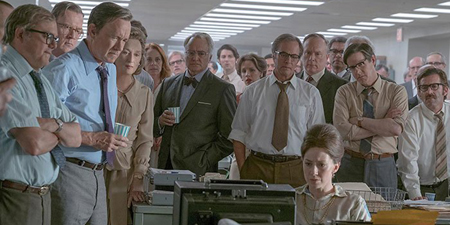
The film 'The Post' celebrates journalism, focusing on the Washington Post's publication of the Pentagon Papers. Directed by Steven Spielberg, it showcases the risks faced by the press in defending truth and freedom.Summary
WASHINGTON - At a time when the media is being accused of peddling "fake news," Steven Spielberg, Meryl Streep and Tom Hanks are bringing Hollywood star power to a movie celebrating journalism and the virtues of a free press.
"The Post," which comes out in theaters in the United States Friday, recounts the nail-biting behind-the-scenes story of the 1971 publication by The Washington Post of the Pentagon Papers, which exposed the lies behind US involvement in the Vietnam War.
Directed by Spielberg, whose long list of credits includes "Saving Private Ryan," "Schindler’s List," "Jaws" and "E.T.," "The Post" stars Streep as aristocratic Post publisher Katharine Graham and Hanks as the newspaper´s scrappy executive editor Ben Bradlee.
The drama at the heart of the film revolves around Graham’s decision to go ahead and publish the Pentagon Papers, a move which could have had potentially fatal consequences for the family newspaper she took over eight years earlier upon the suicide of her husband.
The Pentagon Papers, leaked by whistleblower Daniel Ellsberg, were a 7,000-page classified report which determined - contrary to the public assertions of US government officials - that the Vietnam conflict was unwinnable.
The New York Times published excerpts until the administration of President Richard Nixon obtained a court injunction barring the newspaper from continuing to do so on national security grounds.
That’s where the Post stepped in, braving legal and financial peril to take up the torch.
Spielberg, Streep and Hanks attended a screening of "The Post" at the shrine to journalism, the Newseum, in Washington last week, located just a few blocks from the White House on Pennsylvania Avenue.
Not present but looming over the event was President Donald Trump, who has waged a vitriolic campaign against media outlets he believes are unfair to him.
Trump has been particularly scathing about CNN and The New York Times but he has also repeatedly attacked the Post, calling it "dishonest," "phony" and - his favorite - "fake news."
He refers to the newspaper in his tweets as the "Amazon Washington Post," a reference to Jeff Bezos, the owner of online retail giant Amazon who purchased the Post from the Graham family in 2013.
Speaking to reporters on the red carpet at the Newseum screening, Spielberg, Hanks and Streep - once dismissed by Trump as "overrated" - were reluctant to call out the president by name and downplayed suggestions the movie was a shot across the bow of his White House.
"I think it’s very, very important that our movie is seen not as a political, partisan play on the part of what they call the liberal media or Hollywood," Spielberg said.
"I see it not as a partisan movie," he said, "but a movie about patriotism and a movie about the courageous media, the Fourth Estate, and what they did to be able to get the Pentagon Papers published, which then led to Watergate."
Watergate, of course, was the subject of a 1976 Hollywood blockbuster in which The Washington Post also played a starring role - "All the President’s Men" featuring Robert Redford and Dustin Hoffman as Post reporters Bob Woodward and Carl Bernstein.
Despite Spielberg´s protestations, reviewers are finding parallels inescapable between "The Post" and its championing of the media and the non-stop vilification of the press by Trump.
"(´The Post´) takes you back to a time when the outcome was precarious, and the freedoms we thought we took for granted hung in the balance," said Variety. "Just as they do today."
For The New Yorker, "The Post" is "not a period movie."
"Instead, it is squarely addressed to the present day, striving for the urgency of a headline," it said. "The film is here to warn us of fresh threats to press freedom." - AFP
Key Points
- The film features Meryl Streep and Tom Hanks in lead roles.
- It recounts the 1971 publication of the Pentagon Papers by The Washington Post.
- The Post faced legal and financial risks in publishing the documents.
- The narrative highlights the importance of a free press amid political challenges.
- Spielberg emphasizes the film's focus on patriotism rather than politics.
Relevant Topics
Ask AI: Understand this story your way
AI EnabledDig deeper, ask anything — get instant context, background, and clarity.
Disclaimer: This feature is powered by AI and is intended to help readers explore and understand news stories more easily. While we strive for accuracy, AI-generated responses may occasionally be incomplete or reflect limitations in the underlying model. This feature does not represent the editorial views of JournalismPakistan. For our full, verified reporting, please refer to the original article.