.png)
Journalists assaulted by neo-fascists in Rome
JournalismPakistan.com | Published: 9 January 2019
Join our WhatsApp channel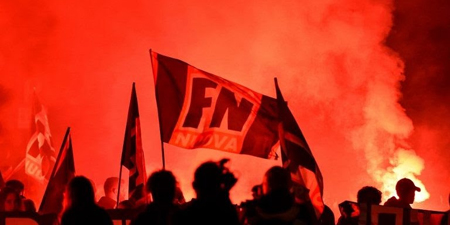
On January 7, 2019, two Italian journalists were attacked by neo-fascist groups in Rome. This incident raises serious concerns about the state of media freedom in Italy.Summary
BRUSSELS - On 7 January 2019, Federico Marconi and Paolo Marchetti, an Italian journalist and a photographer both working for the Italian weekly magazine Espresso, were attacked by members of two neo-fascist groups, Avanguardia Nazionale and Forza Nuova.
The two journalists were near the Verano monumental cemetery in Rome to cover the event organized by Avanguardia Nazionale in memory of the Acca Larentia killings, in 1978.
The International and European Federation of Journalists (IFJ and EFJ) join their Italian affiliate, the Italian Federation of Journalists’ Unions (FNSI), in condemning the attack and express their serious concerns for the increasing climate of violence and threats against journalists in the country.
A group of neo-fascists approached Marchetti and took his camera’s memory card. Other militants then surrounded the journalist Federico Marconi and began to hit him with kicks and slaps. The boss of Forza Nuova together with a militant of Avanguardia Nazionale took the journalist’s mobile phone and the wallet to identify him. They deleted photos and videos of the day from his phone. All their personal effects were not returned to them until the arrival of the police.
Indeed, this is only another example of the dramatic situation of media freedom in Italy. The data published on the Platform of the Council of Europe for the Protection of Journalism shows a serious deterioration of the working conditions of journalists in the country.
Italy is one of the countries with the highest number of alerts in 2018. There are 13 of them, the same number as for Russia. That’s almost as much as the top-ranked countries, Turkey and Ukraine (both with 14 alerts). Italy is also the state whose situation has deteriorated most seriously last year: the number of press freedom violations has more than tripled compared to 2017. No other European state has experienced such degradation. Since July 2017, the Italian authorities have not responded to any of the alerts posted on the Platform.
The majority of alerts recorded in the last year relate to events that occurred after the official installation of the populist government, on 1st June. The two deputy prime ministers of this government, Luigi Di Maio and Matteo Salvini, express on social networks rhetoric particularly hostile to the media and journalists.
Minister Salvini has threatened to abolish police protection for investigative journalist Roberto Saviano. Minister Di Maio insulted journalists and initiated a policy of abolition of public subsidies to the press that may threaten, in the long term, media pluralism in Italy.
Several journalists have been intimidated or even attacked by members of neo-fascist groups throughout 2018. The platform also recorded three cases of journalists facing death threats. According to the Italian Federation of Journalists’ Unions (FNSI), media professionals now face a new threat in the country: a constant risk of violence fueled by the hostile rhetoric of members of the government and ruling coalition parties. – IFJ media release/Photo: AFP
Key Points
- Federico Marconi and Paolo Marchetti were attacked in Rome
- Neo-fascist groups Avanguardia Nazionale and Forza Nuova involved
- The attack occurred during a memorial event for historical killings
- Media freedom in Italy faces serious deterioration and threats
- Government officials have displayed hostile rhetoric towards journalists
Relevant Topics
Ask AI: Understand this story your way
AI EnabledDig deeper, ask anything — get instant context, background, and clarity.
Disclaimer: This feature is powered by AI and is intended to help readers explore and understand news stories more easily. While we strive for accuracy, AI-generated responses may occasionally be incomplete or reflect limitations in the underlying model. This feature does not represent the editorial views of JournalismPakistan. For our full, verified reporting, please refer to the original article.