.png)
It's okay to print profanity
JournalismPakistan.com | Published: 11 October 2019 | Stephen Manuel
Join our WhatsApp channel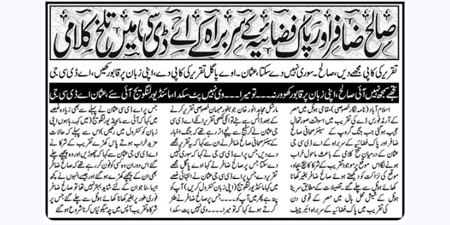
A report in Metro Watch featuring profanity has sparked debate over the declining standards in Pakistani journalism. The incident involves journalist Saleh Zaafir's confrontational behavior towards an ADC, highlighting significant ethical concerns in media practices.Summary
Is it a reflection of the times and the standard journalists have stooped to that it’s now acceptable for sections of the Pakistani print media to publish profanity?
It certainly seems so.
JournalismPakistan.com Editor Imran Naeem Ahmad sent me a link yesterday to a report published by Metro Watch newspaper. I read through it and for quite a while did not know what to think; should I be more dismayed by the quality of writing and language, or should I be shocked by the appalling reported behavior (or lack thereof) of a so-called senior journalist?
Either way, this report should not have found space in any newspaper, and if so, it should have been handled in a mature, sensitive manner and not the vulgar, cheap, in-your-face, exhibition of crassness.
There are two clear-cut grounds for this report to not even have been considered, and somehow, the reporter, the sub-editor, the page in-charge, and editor missed them. Also, there should have been a slew of questions from them about his lack of professionalism. There were none asked.
To begin with, the report hinges on, and also totally blows out of proportion, an apparent tiff between so-called senior journalist Saleh Zaafir, who belongs to the Jang Group of publishers, and G. Osman, the ADC to Pakistan’s Chief of Air Staff, Air Chief Marshal Mujahid Anwar Khan.
According to Metro Watch, events took a turn for the bizarre when the journalist and the ADC clashed soon after the PAF chief had finished speaking at an event to commemorate Egypt’s National Day at the Serena Hotel in Islamabad.
Saleh Zaafir, it is said, asked ADC Osman for a copy of the written speech of the air chief to which the ADC refused and apologized, citing official reasons. He said, “I’m sorry; I cannot give you the speech.”
The Jang journalist is said to have retorted to the refusal by calling the ADC ‘crazy’ and pestering him to hand over the written speech. This angered the ADC, and he admonished Saleh Zaafir and told him to, “Mind your language.” He is also alleged to have made a threat, but it is not clearly reported, “You know what I can do…,” Osman supposedly said.
It is also not known how matters escalated to this point so quickly.
Quite clearly, the journalist overstepped the line. However, the Metro Watch report continues to cast a sympathetic tenor to the reporter’s demanding behavior while portraying the ADC as being haughty and unreasonable.
Now comes the most shocking part. Saleh Zaafir, surrounded by a few cronies, retorts in Punjabi to the alleged threat, and I dare not translate this ‘as is’, but will put forth that the ADC was told by Saleh Zafar in no uncertain terms that the ADC could not do anything, not even “uproot” a specific body part!!
This forced the ADC to warn the Jang journalist again to control his language. Further escalation of the incident, it is reported, was avoided when some members of the audience separated the two after appealing to the ADC to let matters go.
Soon after this, the ADC was on his phone, and Saleh Zaafir was standing nearby when he, reportedly, overheard the ADC say something about him, prompting the Jang journalist to immediately leave the event post haste without eating at the after-event dinner.
Surprisingly the Metro Watch report harps on about how Saleh Zaafir did not eat a single morsel. Honestly, one gets the impression he went there to eat.
Among the other questions I have about this incident, what I want to ask is that being a ‘senior journalist,’ why did Saleh Zafir not record the air chief’s speech, and why did he not take notes when the chief was speaking?
Is it because he is an alleged “senior journalist,” and it is beneath his dignity to do so, or is it because he has been spoiled rotten through years by others doing his bidding and spoon-feeding him?
As a “senior” journalist, is it becoming of him to pester anyone for written material about an event?
What is the job of a journalist, a reporter?
Is it not to report factually about an event/incident, to take notes, to observe, to listen, and to write objectively?
And since when have media personnel become the new thugs that can go around threatening people. What in the name of heaven is: “You cannot even uproot my….” if it is not a threat?
Do not be surprised, therefore, if one now comes across reports that some individual, a politician, a journalist, a doctor, a police officer saying, “teri maa di…” or “Meray….. tay..…!!”
If that is the future of reporting and journalism in Pakistan, then count me out. I don’t want to be known as a journalist.
Key Points
- Metro Watch published a report featuring profanity from journalist Saleh Zaafir.
- The incident occurred after an event commemorating Egypt's National Day.
- Zaafir's confrontational language towards an ADC raises questions about journalistic ethics.
- The report reflects a broader concern over language and professionalism in the media.
- This situation illustrates a troubling trend in Pakistani journalism.
Relevant Topics
Ask AI: Understand this story your way
AI EnabledDig deeper, ask anything — get instant context, background, and clarity.
Disclaimer: This feature is powered by AI and is intended to help readers explore and understand news stories more easily. While we strive for accuracy, AI-generated responses may occasionally be incomplete or reflect limitations in the underlying model. This feature does not represent the editorial views of JournalismPakistan. For our full, verified reporting, please refer to the original article.