
Freedom Network report reveals how Pakistan's legal system has failed the murdered journalists
JournalismPakistan.com | Published: 31 October 2018
Join our WhatsApp channel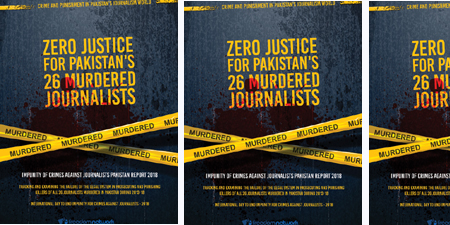
A new report from Freedom Network shows that only one of 26 murdered journalists in Pakistan received justice in the past five years. The findings highlight significant failures in both prosecution and investigation processes.Summary
ISLAMABAD – Of the 26 journalists murdered in Pakistan during the last five years for their work, the cases of only 16 went to court for the trial of which prosecution and trial were concluded in only six cases and conviction handed in just one case.
This was revealed in a new research tracking and examining the failure of the justice system in prosecuting and punishing the killers of all journalists killed in Pakistan between May 2013 and May 2018.
The ‘Impunity of Crimes Against Journalists Pakistan Report 2018’ has been produced by Freedom Network, a national independent organization that monitors attacks against journalists and works on journalists’ safety issues is titled “Crime and Punishment in Pakistan’s Journalism World: Zero Justice for Pakistan’s 26 Murdered Journalists.”
The release of the report comes on the eve of the International Day to End Impunity for Crimes against Journalists observed by the United Nations on November 2 every year.
The impunity enjoyed by the killers of journalists in Pakistan is one of the highest in the world and the murdered journalists and their families have received justice in only one of the 26 cases. In this case, also, a conviction was handed down by a lower court, but the accused was able to get the sentence overturned at the high court level.
“Journalists continue to get target killed and threats against them continue to grow and the State's legal system (police failure) and justice system (courts failure) have failed to provide them justice,” Iqbal Khattak, the Executive Director of Freedom Network said on the occasion. He urged all stakeholders of media to join hands to fight back deep-rooted impunity for crimes against journalists and media.
“This means the killers enjoy total impunity with no fear of getting punished for killing journalists. Journalists are dead and their killers are free,” he went on to add.
The report is the first of its kind that focuses on the impunity of crimes against journalists based on a special impunity index developed by Freedom Network. It is based on examination of the FIRs of journalists and interviews with the families, lawyers and former colleagues of the murdered journalists.
The report’s findings:
Most dangerous medium and province
Newspaper journalists (18 of 26 killed) are three times more vulnerable than TV journalists (8 killed). Punjab is the most dangerous province in Pakistan to practice journalism (8 killed) followed by Khyber Pakhtunkhwa (7 killed). Print journalists are at most risk of being murdered if they are based in Punjab (6 killed) and KP (6 killed) and TV journalists if they are based in Sindh (4 killed) and Punjab (2 killed).
Memberships of press clubs and unions of journalists
Whether they are members of press clubs and unions of journalists or not, journalists across Pakistan are equally vulnerable to the risk of being murdered. Three out of every four journalists target killed were members of local press clubs but only one in three were members of their local union of journalists. Sindh and KP are the most dangerous regions of Pakistan for journalists who are not members of any press club while Punjab is the most dangerous region in Pakistan for a journalist if they are not members of a union of journalists.
Worst enemies of journalists
Most murderers of journalists remain faceless and unidentified. The threat sources are identified/suspected by the victims and their families in only one in every three cases of journalists murdered and worryingly include state actors, political parties and religious groups.
Deadly inaction
In three-fourth cases, the local state authorities were pre-informed by journalists of threats they were facing before being murdered. Despite this avalanche of early warning and threat reporting, the authorities failed to prevent their murders.
Incomplete investigation – police failures
In 60% of the cases the police fail to complete the investigations into the murder of a journalist to generate a final challan – or a full investigation report – to submit before a court for trial. Of the 26 journalists murdered, the cases of only 16 reached the court. One in three journalists murdered in Pakistan for their journalism work is pre-guaranteed to NOT get justice because their case never goes to a court for trial because of the failure of the police. The performance of police in the investigation of the murder of journalists and producing a final challan is the worst in KP province where only one in six cases reached this stage. In Punjab, the police failed to produce a final challan in one-third of the cases and in Balochistan and Sindh in one in every five cases.
Incomplete trial – court failures
Barely a third of the cases of murdered journalists in Pakistan is declared fit for trial in a court of law and completes prosecution in the court. The process of justice for two of every three journalists murdered in Pakistan whose case even reaches the court does not even conclude. Courts in Balochistan and Punjab are the slowest in completing trials of cases of journalists declared fit for prosecution.
Zero punishment – justice failures
The level of impunity enjoyed by killers of journalists in Pakistan is near-complete. The killer of only one of the 26 journalists murdered in the period 2013-18 was convicted (3.5%). The only case of conviction of an accused killer was at the district court level in KP after which he successfully challenged the conviction at the high court level.
The report makes four recommendations to successfully combat the impunity of crimes against journalists in Pakistan:
- Enactment of special federal and provincial laws for the safety of journalists to obligate the legal system to protect journalists.
- Appointing special federal and provincial prosecutors on the safety of journalists to improve the prosecution of cases.
- Amending the constitutions and charters of all key representative associations of media to declare the safety of journalists a mission.
- Instituting safety policies and safety protocols within media houses to pre-empt and minimize threats.
Pakistan has been consistently ranked by international media watchdogs as one of the most dangerous places on the planet to practice journalism. The levels of impunity enjoyed by killers of journalists are shockingly high. Over 120 journalists have been killed since 2000 and over 2,000 attacked, injured, kidnapped, arrested or intimidated. – A Freedom Network media release
Key Points
- Only one conviction for 26 murdered journalists in five years.
- Impunity in Pakistan ranks among the highest globally.
- Most murders are committed against newspaper journalists.
- 60% of police investigations into these cases remain incomplete.
- The report recommends stronger legal protections for journalists.
Relevant Topics
Ask AI: Understand this story your way
AI EnabledDig deeper, ask anything — get instant context, background, and clarity.
Disclaimer: This feature is powered by AI and is intended to help readers explore and understand news stories more easily. While we strive for accuracy, AI-generated responses may occasionally be incomplete or reflect limitations in the underlying model. This feature does not represent the editorial views of JournalismPakistan. For our full, verified reporting, please refer to the original article.