
PFUJ, civil society and others reject Citizens Protection Rules
JournalismPakistan.com | Published 5 years ago
Join our WhatsApp channel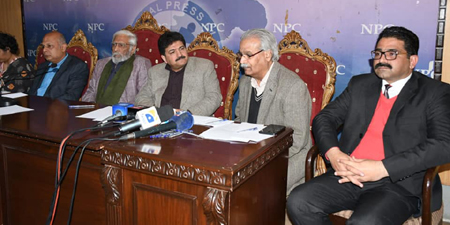
ISLAMABAD—Terming Citizens Protection (Against Online Harm) Rules 2020 an attack on fundamental rights of freedom of expression and a threat to country’s digital economy, journalist union, lawyer’s associations, and civil society, on Thursday, rejected the new rules and urged the government to denotify these rules immediately.
In a joint press conference organized by the Pakistan Federal Union of Journalists (PFUJ) in collaboration with Media Matters for Democracy (MMFD), the union leaders and rights activists demanded that the government bring any such regulation on social media after proper consultation with the stakeholders.
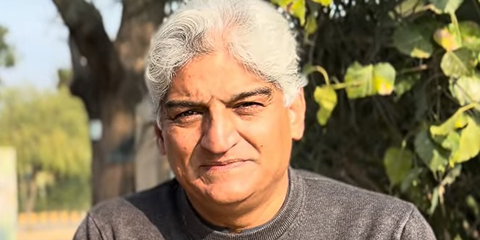
The press conference was addressed by the General Secretary of PFUJ Nasir Zaidi; General Secretary Human Rights Commission of Pakistan Haris Khaleeq; General Secretary Islamabad Bar Council Umair Baloch, senior journalists M. Ziauddin and Hamid Mir and co-founder of MMFD Sadaf Baig.
A statement regarding the rules was presented by Nasir Zaidi which was endorsed by the PFUJ, Supreme Court Bar Association, Islamabad High Court Bar Association, Rawalpindi High Court Bar Association and senior journalists and human rights activists.
The speakers said that the new rules give the impression that this law has been made to curb the fundamental right of freedom of expression of the general public. They termed it a positive sign that Prime Minister Imran Khan had directed the relevant department to review the rules before implementation. But they urged the prime minister to immediately denotify these rules through written order and issue a comprehensive consultation plan for any future regulation on social media.
While announcing the future strategy, Nasir Zaidi said that PFUJ has announced nationwide protests against the Citizens Protection (Against Online Harm) Rules 2020. “The Pakistan Federal Union of Journalists will hold joint press conferences in Karachi, Lahore, Peshawar, and Quetta Press Clubs. Besides, a national conference will be organized on February 27 at the National Press Club, where a declaration will be passed, presenting the demands of media and civil society."
Sadaf Baig said that the government is giving the wrong impression that the rules were formulated to protect Pakistani users from online harm and it will help generate revenue through the digital app economy. "Millions of people are running their businesses through digital media which is much larger than app economy," she said while asking the government to clarify the legal status of these rules. "Only Parliament has the right to formulate and amend laws. These rules are a violation of the rights of Parliament."
While presenting the view of HRCP, Haris Khaleeq said that these rules violate political, cultural and economic rights of the general public. He said that people, especially human rights defenders, are already working under strict surveillance. He endorsed the statement presented by PFUJ.
Hamid Mir said that the new rules are anti-Pakistan and will damage the image of the country internationally. He said that FIA is already performing the role of implementing agency of laws related to the digital world and the creation of new mechanisms with extraordinary powers given to national coordinator shows the ill intention of the government.
The collective statement issued said that it is a matter of concern that the power of the national coordinator could be misused to target warranted criticism by Pakistani citizens and the credible reporting of a news organization. The social media rules make no mention of the constitutionally guaranteed rights of Pakistani citizens, including the right to freedom of expression. The rules only focus on blocking and removal of content.
It says that the Pakistan Tehreek-e-Insaf and other political parties effectively used social media during their election campaigns and political leaders use these networks regularly to stay in touch with their constituents as well as to comment on current affairs. Social welfare organizations use social media networks to highlight issues of public importance and spread awareness of noble causes. Similarly, the government has used social media to project the country’s positive image, conduct public diplomacy, and issue statements related to its foreign policy. If it comes to the complete blocking of social networks, the government, the political parties, and the civil society organizations will be robbed of these opportunities.
The statement added that the Asia Internet Coalition, whose members include tech giants such as Facebook, Google, and Twitter, has written to the government saying that if the rules are not revoked, the country’s digital economy will be “severely crippled.” The coalition has said that the rules will make it difficult for Internet companies to offer their services to Pakistani users and businesses. It has also noted that the rules demand social media companies to deviate from established human rights practices. Other international organizations, such as the Committee to Protect Journalists and Reporters without Borders, have also condemned the social media rules.
The statement pointed out that these rules violate the limits set by the parent legislation, PECA 2016. These social media rules were formulated without any public consultation. They give unfettered authority to the national coordinator’s office over the content. Even the process of designating the national coordinator and the qualifications for the designated official has not been specified.